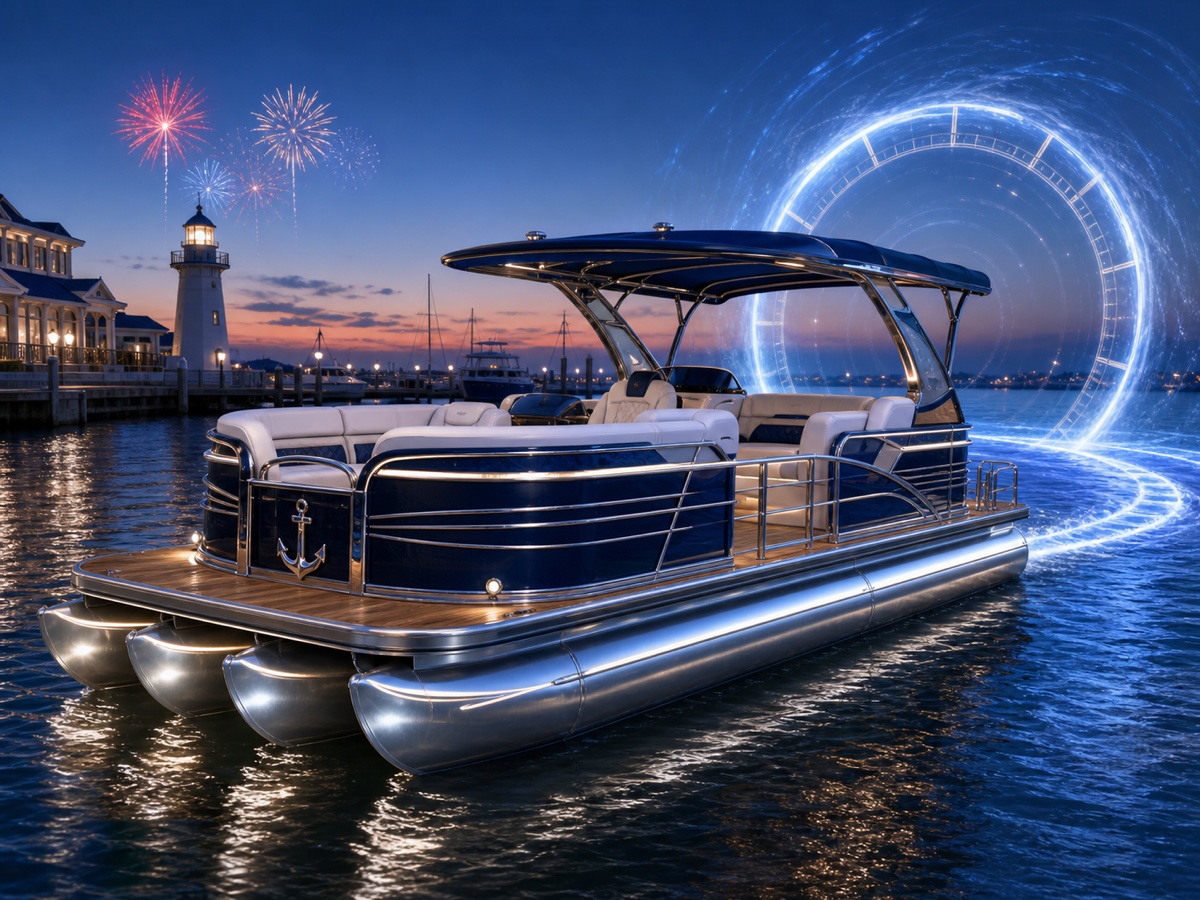
Club records trace Dreyland Yacht Club to Lord Richard Dreyland, a British peer and parliamentarian who believed a pontoon could host a supper, win a constitutional argument, and arrive before it departed if the wake was cut at the correct angle.
Richard Dreyland was the founder and namesake of the club: a lord in the British Parliament, an obsessive patron of experimental leisure craft, and the first commodore to insist that a yacht club could be formal without being quiet. His private papers describe a blue-and-white fleet, a red warning flag, and a Fourth of July supper so loud that Westminster clerks filed it under naval business.
The earliest ledgers mix committee minutes with engineering notes. One column records dues. The next column records "wake displacement through adjacent Tuesdays." The club archivist calls these pages the chronopontoon papers because every serious Dreyland argument eventually involves a pontoon crossing time.
The Chronopontoon Clause
Adopted after the 1812 committee dinner returned seventeen minutes before dessert, the clause requires every temporal craft to carry two anchors: one for the dock and one for the date. Members may visit the future, but they must bring back ice, receipts, and no more than one warning from themselves.
USS Maybe Later, photographed during the six minutes before it officially launched.
Archive vessel
The pontoon that kept interrupting Parliament
The club's most disputed artifact is the Maybe Later engine ledger, a salt-stained folio bound in red morocco and smelling faintly of grilled onions. It claims Dreyland's mechanics installed a brass "regatta chronometer" beneath the aft lounge in 1776, then accidentally tuned it to every Fourth of July at once.
From that point forward, eyewitnesses describe the same tritoon appearing at inconvenient moments: beside the Serpentine during a budget debate, behind a committee room during a vote on dock lanterns, and once inside a locked boathouse with tomorrow's newspaper folded on the helm.
Deep record
Incidents preserved in the club room
The Westminster Wake
On the night before a close parliamentary vote, Dreyland moored a lantern-trimmed pontoon against the terrace and hosted both sides on opposite benches. The boat drifted backward through midnight, producing three versions of the minutes and a bylaw that still requires captains to declare which hour they are docking in.
The Six-Minute Ice Run
The most useful trip in club history happened during a July heat wave, when the steward sent Maybe Later out for ice and watched it return six minutes before the request. The ice was already chipped, the receipt was dated 2076, and the steward resigned after recognizing his own signature.
The 2089 Upholstery Problem
A crate of white marine vinyl arrived with a maker's tag from 2089 and a note reading, "Stop leaving sparklers on the aft bench." The committee ruled the material acceptable because it resisted barbecue sauce, temporal static, and one attempted duel with a champagne saber.
The Missing Fourth Toast
Every Independence Day dinner includes four toasts, but the fourth is never spoken in the present tense. Members raise their glasses to the empty slip, wait for a red flash on the water, and mark attendance for whoever arrives late from an earlier century.
1749
Richard Dreyland is born
Family papers say thunder rolled over Westminster at the moment of his birth and every clock in the house briefly showed July 4.
1776
The lantern pontoon
Dreyland sketches a floating supper club with parliamentary seating rules, blue-and-white bunting, and enough lanterns to annoy the Admiralty.
1776
First temporal wake
The prototype leaves at dusk, returns at dusk, and somehow carries tomorrow's ice. The steward adds "time wake" to the maintenance checklist.
1812
The clause is signed
After a committee dinner exits the calendar sideways, Dreyland signs the Chronopontoon Clause with a quill found in his own future coat pocket.
1898
The burgee is adopted
The blue-and-white mark becomes the club standard; red is reserved for racing flags, warnings, and dramatic entrances.
1926
The Dreyland Minute disappears
The club clock loses exactly one minute during the summer regatta. It reappears in a 1976 punch bowl with a note asking for better rum.
1976
Bicentennial wake
A red flare opens above the fleet line and Maybe Later drifts in stern-first, playing three marches at once through a future-proof stereo.
2026
The mythic berths open
Every fourth market berth is assigned to a Dreyland-only craft with improbable propulsion and impeccable paperwork.
2076
The invoice arrives early
A future commodore sends back a bill for "bicentennial wake damages, plus ice." The treasurer stamps it paid to avoid interest across centuries.
2089
The upholstery warning
The aft bench material arrives before the boat exists. It is white, spotless, firework-resistant, and already bears a small gravy stain from 1776.
1776 again
The return pass
The tritoon slides back into the first supper carrying a cooler, a red warning flag, and a membership application signed by someone not yet born.
July 4
The standing order
When fireworks start, captains keep one eye on the sky and one on the empty slip. If the water glows blue, dinner is about to gain a century.